
Lamar County Scheduled vs Actual Release
A projected release date is an estimate or calculated date based on the sentence, credits, custody status, and orders in effect at that time. An actual release date is the date the person physically leaves the jail or prison, or is transferred out of that facility's custody. Those two dates can match, but they often do not. Holds, court orders, release processing, good-time changes, and parole decisions can move the final result.
For Lamar County Jail, the release date often starts with local facts. A person awaiting trial may leave after bond, recognizance release, dismissal, a court order, or the end of a short sentence. The county budget source identifies Lamar County Jail as holding people awaiting trial or serving short sentences. That means ADOC prison statutes should not be applied automatically to a local jail stay.
A pretrial detainee usually has no set release date. The next release event depends on bond, court action, holds, or case disposition.
For a state prisoner sentenced from Lamar County, the question shifts to the Alabama Department of Corrections and the Alabama Bureau of Pardons and Paroles. ADOC can be the current custody source while the person is incarcerated in state prison. ABPP controls parole consideration and supervision channels. Court records remain important because sentencing orders, jail credit, and later orders can affect release timing.
Find Lamar County Inmate Release Date
Start by deciding whether the person is in Lamar County Jail, ADOC custody, federal custody, immigration custody, or already released to supervision. A release-date search fails when those systems are mixed together. A Lamar County Jail bond release is not an ADOC discharge. A transfer from jail to prison is not a community release. A parole set date is not a guaranteed release date.
- For a person believed to be in Lamar County Jail, call the jail or sheriff first and ask whether the person is still in custody.
- Check the Lamar County court docket for bond orders, dismissal, sentence, probation, revocation, hold, or transfer entries tied to release.
- If the person was sentenced to state prison, search ADOC by AIS number when known, or by first and last name.
- On a current ADOC record, look for the release-date or projected/minimum-release field shown on the detail page. Do not invent an exact label if the screen does not show one.
- For parole timing, check ABPP's parole FAQ, scheduled hearings, and later hearing results.
- For written proof, request the record from the agency that holds it: jail, court, ADOC, ABPP, BOP, or ICE as the custody path requires.
The ADOC inmate search is the official state-prison lookup, but it has a major limit: the public page says the database contains currently incarcerated inmates only and historical data is not available online. For a Lamar County released-person question, an ADOC no-result may only mean the person is not currently in ADOC custody. Use the Lamar County released inmates search path for jail release records, court explanations, supervision checks, and request fallbacks.
Lamar County ADOC Date Checks
ADOC applies when a Lamar County case becomes a state-prison case. A person may be arrested locally, held at Lamar County Jail, sentenced in court, and then transferred into ADOC. The jail release event in that situation is a transfer to state prison, not a release to the community. Once the person enters ADOC custody, the state search becomes the better place to check current prison custody and any projected release information shown on the active record.
| ADOC search item | Research-supported use |
|---|---|
| AIS number | ADOC says the Alabama Institutional Serial number is a unique six-digit number and takes priority over name fields. |
| First and last name | Name searches can be used together, with open-ended behavior and a 50-result cap. |
| Current custody record | Useful for a current state prisoner, not a historical release archive. |
| Release-date field | Read the detail page carefully and use the exact label shown on screen when available. |
| No result | May mean not currently in ADOC custody, Youthful Offender exclusion, name mismatch, or another nonpublic status. |
The ADOC current-custody limitation is central. A former state prisoner may need ADOC Central Records, ABPP supervision records, Alabama VNS, court records, or a public-records request for confirmation after release. For a county jail detainee who never entered ADOC custody, use the jail and court instead.
Alabama Good-Time Release Rules
Alabama release timing is not a simple calendar subtraction. Alabama Code Section 14-9-41 governs correctional incentive time. The statute creates incentive-time classes, excludes many prisoners from earning correctional incentive time, and addresses forfeiture and possible restoration. The research notes exclusions for Class A felony convictions, crimes causing death by deadly weapon, life or death sentences, sentences over 15 years, and sex offenses involving a child.
Alabama Code Section 14-9-64 adds education incentive time. It caps education incentive time at 12 months during any term of incarceration and says those deductions are in addition to other available sentence deductions, including correctional incentive time. A projected date can move because credits are earned, lost, restored, or added after education credit, court credit, or sentence review.
The screenshot below comes from the official statute source for correctional incentive time used in Lamar County release-date content.
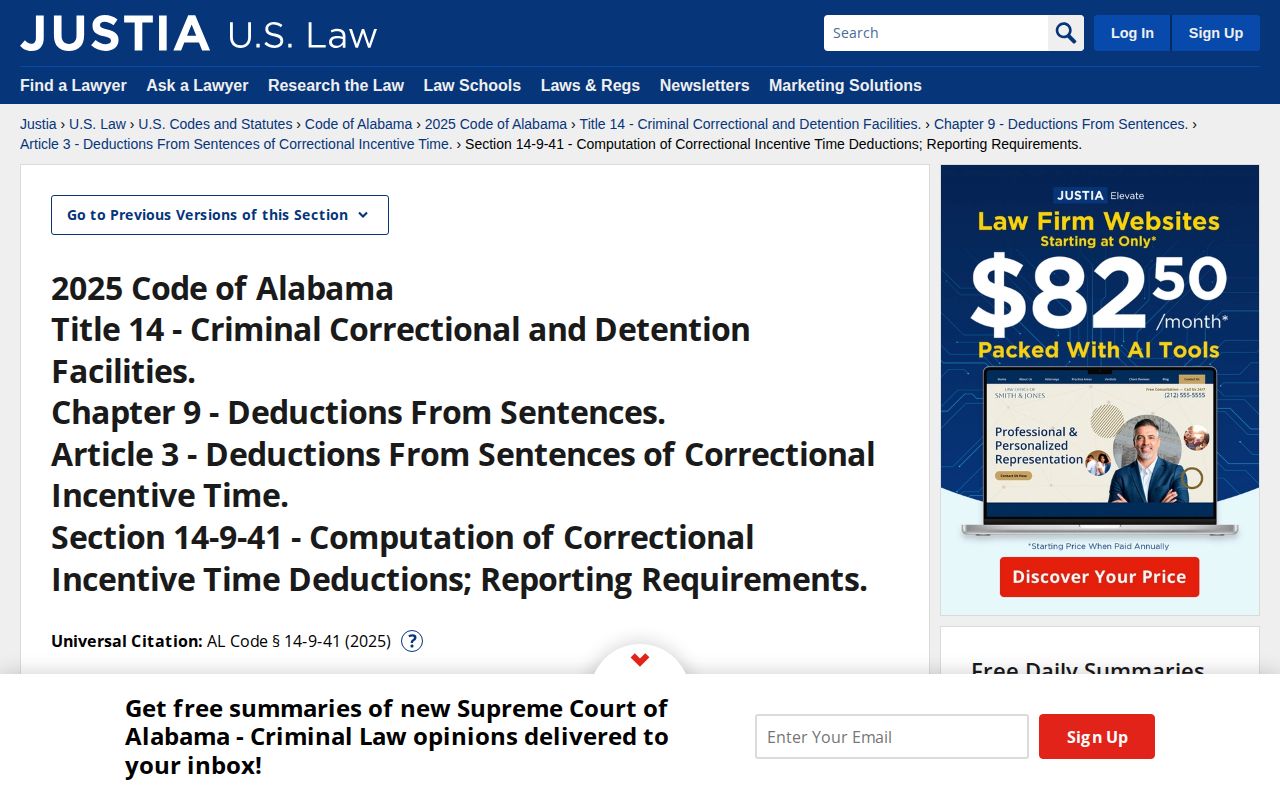
The statute supports a careful good-time explanation: release dates are calculated under Alabama law and agency records, not by applying a single fixed percentage to every sentence.
Do not write that every Alabama prisoner serves exactly 85 percent. Federal shorthand and other states' truth-in-sentencing rules do not control every Alabama sentence. Alabama timing depends on the offense, sentence, statutory exclusions, court orders, jail credit, ADOC calculations, and ABPP decisions.
Lamar County Parole Timing
Parole eligibility is a consideration milestone, not an inmate release date. Alabama Code Section 15-22-26 states that parole is not merely a reward for good conduct and requires the Board's opinion under criteria and guidelines. Alabama Code Section 15-22-28 governs investigation and initial consideration timing. ABPP's parole FAQ says eligibility consideration is calculated under Section 15-22-28(e).
ABPP says sentence, crime, jail credit, ability to earn good time, time served, and sentencing-court orders can affect eligibility. Once eligibility is calculated, the inmate receives a letter with a parole consideration eligibility date or "set date" showing a month and year. That set date means the person can be considered. It does not mean the person will be released that month.
The ABPP parole FAQ is the source for this eligibility distinction. The matched screenshot below shows the state parole eligibility explanation used for Lamar County release-date guidance.
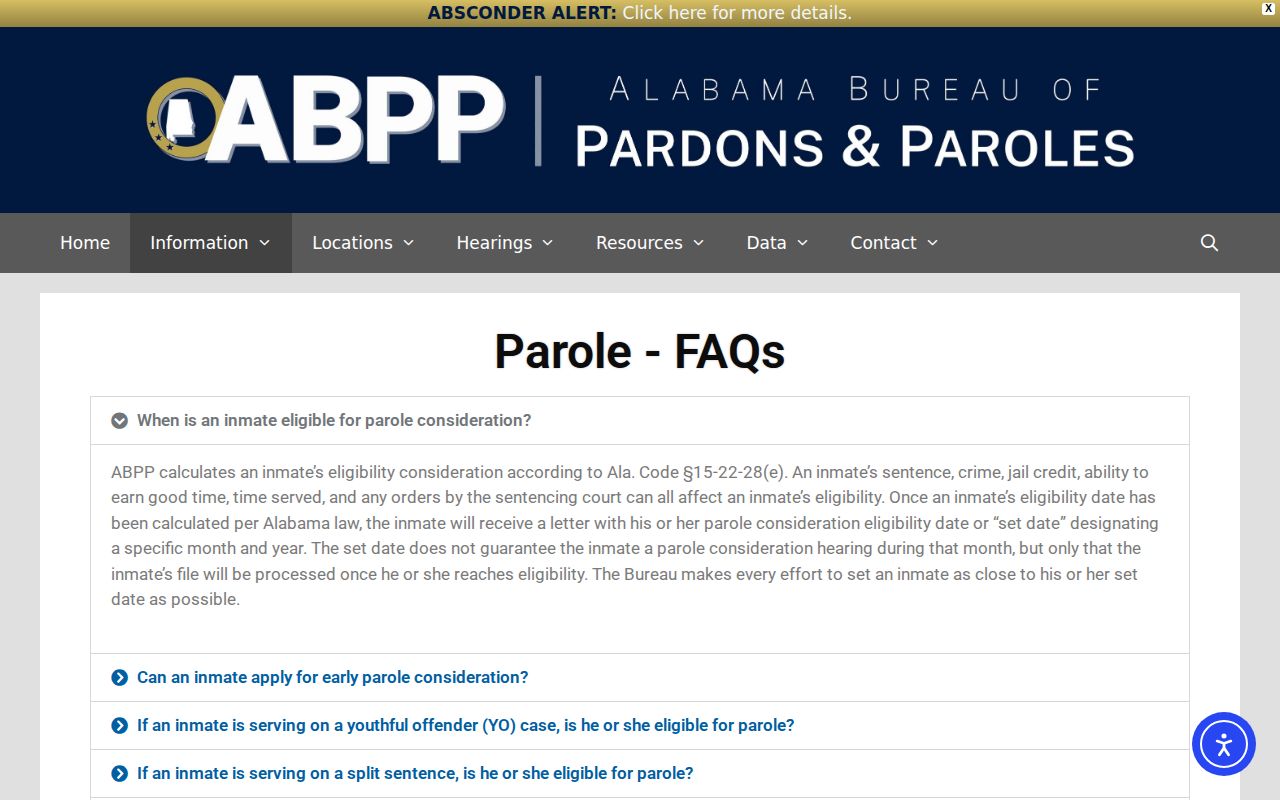
For parole cases, pair the set date with scheduled hearings and hearing results. A grant may still require processing, release conditions, detainer review, notification steps, and an approved release plan. A denial leaves the state-prison release calculation in place unless another lawful release path applies.
Why Lamar County Dates Change
A release date can change for reasons that are lawful and routine. Some changes help the person leave sooner, such as earned credits or corrected jail credit. Others delay release, such as a detainer, hold, disciplinary loss of good time, or a new court order. The agency holding the person is the only source that can confirm the active calculation.
| Factor | How it changes the date |
|---|---|
| Jail credit | Credit for time already served can alter the remaining sentence. |
| Correctional incentive time | Credits under Alabama law can reduce time when the person is eligible. |
| Education incentive time | Education credit may add deductions within the statutory cap. |
| Forfeiture or restoration | Lost or restored credits can move the projected date later or earlier. |
| Detainer or hold | Another agency may take custody even when the local or prison sentence ends. |
| Court order | Sentencing amendments, revocations, or corrections can change custody time. |
| Parole decision | A grant, denial, continuance, or cancellation affects parole release timing but not every sentence end date. |
Local jail dates can change for simpler reasons too. A person may post bond, have bond modified, resolve a hold, be sentenced to time served, be transferred to ADOC, or be held on another warrant. No Lamar-specific jail good-time policy or weekend-release rule was located in the research, so the jail and court are the correct confirmation points for a local sentence.
Lamar County Jail Date Checks
Lamar County Jail release-date questions should be handled locally unless the person has moved to another system. The county budget source places the jail at 1118 County Road 9 in Vernon and describes it as a detention facility for people awaiting trial or serving short sentences. That makes the jail the first call for a current detainee and the court the main record source for the legal event behind release.
Ask jail staff whether the person is still in custody, whether a release date or time can be confirmed, and whether the release was bond, time served, transfer, court order, or another reason if that information is public. If staff cannot provide a written answer by phone, ask what request process applies to booking and release entries. For older or formal records, a narrow request should include the person's full name, date of birth if known, booking date range, and the specific release fields needed.
The Lamar County Circuit Clerk and Alacourt access path can explain why a person left jail. Court entries may show bond, dismissal, sentence, probation, revocation, failure to appear, warrant recall, or transfer. The court record should not be stretched beyond what it says. A release from jail does not always mean the criminal case is over.
Note: A transfer out of Lamar County Jail can look like a release from the jail while the person remains in ADOC, BOP, ICE, or another agency's custody.
Confirm Lamar County Release Date
Confirmation should match the system that controls the person. Lamar County Jail confirms local custody and jail release entries. The court confirms orders and disposition. ADOC confirms current state-prison custody and records in its control. ABPP confirms parole and probation supervision records where public. BOP confirms federal custody and past federal release dates when the person was in federal prison. ICE confirms current immigration detention status when applicable.
VINELink and Alabama VNS can help with release alerts, but they do not replace the record-holding agency. Alabama VNS is limited to offenders convicted in Alabama and sentenced to ADOC custody, so it is not enough for a Lamar County Jail pretrial release. Use the VINELink Release Check path for alerts, then confirm the final date through the jail, court, ADOC, ABPP, BOP, or ICE as the case requires.
Written requests should be specific. For a jail record, ask for the public booking and release record for a named person and date range, including booking number, booking date and time, release date and time, release reason or type, charges, court case number, bond information if public, transfer destination if any, and booking photograph if publicly releasable. For ADOC or ABPP, use their separate public-records processes and do not route state-prison or supervision questions to the county jail unless the county record is the missing link.